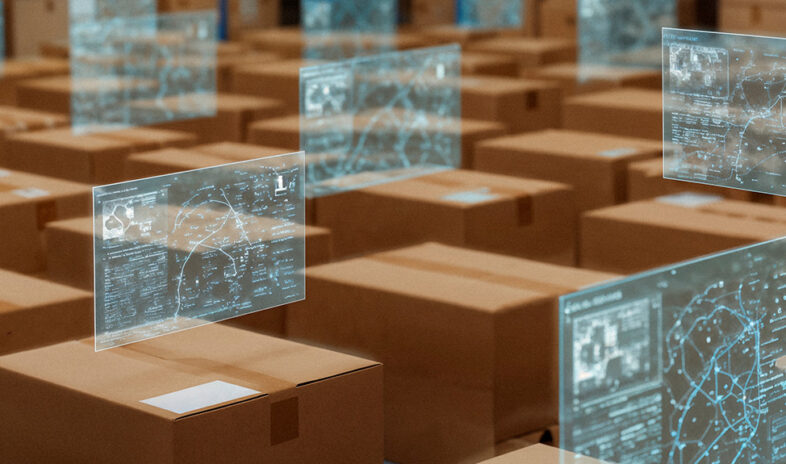
For distribution centres and logistics, material handling technology is a vital part of the forecast for the new year. However, it’s not as simple as AI becoming more powerful or automation becoming more efficient. It’s about how these technologies will be used in ways that make a difference.
Some of the crucial areas where there is need for improvement are avoiding risks and optimising processes – and distribution centres in 2026 are likely to be using available technologies, combined with logistics expertise, to make a difference in these areas.
Alongside this, the forecast suggests that distribution centres also need to protect what they have, with security an ever-increasing concern and customer demands needing to be met.
1. AI will grow in importance
AI is only growing in sophistication and impact, which has already started to make a difference to distribution centres. 2026 will see the continuation of this, but not necessarily in the expected ways.
AI will not transform logistics processes in large, all-encompassing ways, rather it will be expertly applied to parts of operations in order to optimise and transform steps. Examples of this can include using AI to suggest next actions, trigger inventory checks, or manage environmental levels within warehouses. As up to 85% of warehouses look set to implement AI in 2026, it’s clear that those who do not will struggle to achieve the same results.
2. Smarter use of automation is vital for optimisation
Automation is not new to distribution centres, but it will grow in use even further, particularly being used to replace tasks that are still manual in some places, such as sorting, picking and packing. As automated solutions grow in efficiency and effectiveness, they offer ways in which distribution centres can optimise both their workflows and their working conditions.
Operations will be faster, and manual labour will be upskilled to operational management, providing a more healthy workplace with more attractive benefits. Together, these will result in fewer errors and a more efficient workplace.
3. Robotics are key for flexibility
Robotics in distribution centres are forecast to improve over 2026. As part of the automation and AI developments, robots will become used for certain parts of processes, for example with AMRs moving goods through the centre, or picking robots managing certain tasks.
As warehouses in 2026 must be efficient and able to upscale or downscale operations, robotics offers a modular way to handle this process if integrated with care and if the system supplier recommendations are followed.
4. IoT can helps with central control
IoT relates to the interconnecting devices used across a site – in this case, an Internet of Warehouse Things is the network of physical appliances and sensors used in the distribution centre and the software, sensors and connectivity that connect their data.
By allowing all the technologies to connect into one integrated whole, it can provide real-time tracking and visibility, predictive maintenance and immediate notifications of any issues within the systems, and faster responses to errors. This ensures that monitoring of everything necessary is providing and creates a better working environment.
Having an Internet of Warehouse Things helps distribution centres work more dynamically, with benefits to all processes.
5. AR & VR will help with employee training
Augmented Reality & Virtual Reality (AR & VR) are technologies that are set to help distribution centres truly utilise digital and artificial advancements across a vital area that is often overlooked – employee training.
While distribution centres are a hub of activity, operators are often trained on the job as this has previously been the only option. AR and VR change this, allowing operators to make use of virtual situations or augmented reality to understand the processes, tasks and scenarios without being in a place where they risk impacting every day operations.
On a more advanced level, they also allow managers to understand the impact of different scenarios and plan for changes to circumstances – all of which ensure that the distribution centre will continue to operate in an optimal manner, regardless of other factors.
6. Cybersecurity remains a risk
Cyber attacks are increasing in complexity, and distribution centres are equally at risk. The cost of a successful attack is significant, with loss of money and reputation, meaning that cybersecurity is set to become more important than previously in 2026.
Whether it’s external security systems teams, consultants, or a larger internal team, every member of the distribution centre needs to be aware of secure best practices and what to do in case of an emergency.
7. Omnichannel flexibility must be managed smoothly
Distribution centres used to function in a linear manner – but that’s no longer the case. A shift towards omnichannel retail and a subsequent need for efficient returns handling that uses advanced reversed logistics means distribution centres that cannot keep up with omnichannel flexibility are falling behind on efficiency.
Distribution centres need to be able to manage flexibility, through pouch sorters, specific robots, modular sorters, intelligent templates, or the precise scenarios that work for them. Omnichannel flexibility is now the expectation, and distribution centres must provide it.
8. Sustainability must be at the centre of operations
Sustainability continues to be a priority – both for lawmakers, businesses and individuals. Distribution centres must comply with new demands for proven carbon efficiency while also catering to customers who want proven green approaches.
It’s no longer sufficient to have some sustainable options, distribution centres must plan for, comply with, and record their carbon-emitting processes and continually be concerned with how to ensure they are operating in the most environmentally friendly manners, from the vehicles they use to the machines they rely on.
9. Localised distribution centres for more efficient services
In 2026, distribution centres are expected to continue and advance their move from large centres to smaller, more local ones. Already, large companies such as Amazon are focusing on ‘micro-hubs’, in urban areas that can offer faster and more efficient customer service. Their location means they can offer faster times and more resilient solutions, while also ensuring that they have space that may not be possible to achieve in other ways.
10. Transparency grows in importance
Across all actions, transparency is gaining importance in 2026. Customers demand to know where their parcels are, at all times, regulations and cross-border checks need to know the details of the parcel, operators need to understand where issues are in their workflow so they can adapt or change processes as needed, and managers need to know when to make changes to templates or automation flows.
Real-time transparency and data is what allows all these things to be achieved, and it is set to become more important in 2026 than it has been before.