warehouse-sortation-system-process-overview
Home > Knowledge > Warehouse & Distribution > Warehouse sortation systems: From design to real-world performance

Warehouse sortation systems: From design to real-world performance

Many distribution centres are reaching a tipping point. Order volumes are rising, SKU complexity is increasing, and available space is often already stretched. At the same time, customers expect faster and more accurate delivery.

In this environment, warehouse sortation systems extend beyond a purely operational role. They act as critical strategic enablers of performance, scalability, and profitability.

This guide covers the full scope of modern warehouse sortation systems — from core sorting technologies to the software, controls, and system design, which is key to define efficiency and accuracy.

It explains how these elements interact to drive overall warehouse and distribution centre performance and outlines the key considerations for achieving high throughput, accuracy, and long-term scalability.

TABLE OF CONTENTS

WHAT IS A MODERN WAREHOUSE SORTATION SYSTEM?

A warehouse sortation system identifies items and automatically routes them to the correct destination within a warehouse or distribution centre.
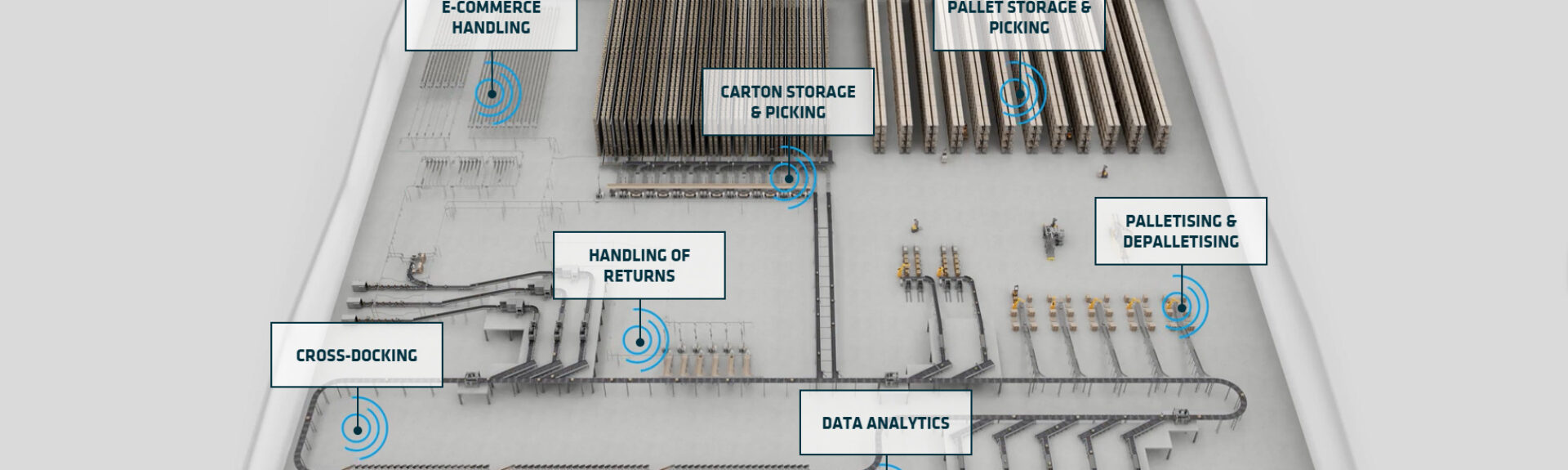
Rather than being a single machine, a warehouse sortation system is made up of multiple technologies and processes working together to move items efficiently, often at high speed and within limited space.

A sortation system typically includes:

  • Induction areas where items enter the system.
  • Conveyor networks that transport goods through the facility.
  • Sorting technologies such as tilt-tray, cross-belt, line sorters, or pouch systems.
  • Divert lanes and discharge points where items are routed to orders, zones, or destinations.
  • Software and control systems that manage routing logic, flow optimisation, and system performance.

In modern operations, these systems are increasingly complemented by robotic solutions for induction, picking, or packing, all integrated into the overall material flow.

SYSTEM DESIGN DETERMINES REAL-WORLD PERFORMANCE

In warehouse sortation systems, performance depends on more than just the sorter — it depends on how the entire system is designed and integrated, as highlighted in industry research.
The research suggests many operations fall short due to fragmented system design and weak integration across warehouse technologies and processes. A system may meet its technical specifications, yet still underperform once it is live:

  • Induction constraints can limit throughput regardless of sorter capacity
  • Inefficient routing logic can create congestion in advanced, high-speed systems
  • Poor integration between picking, sortation, and packing can reduce overall flow efficiency

Throughput is determined by the entire operation, including induction rates, parcel flow variability, SKU complexity, routing logic, and system controls.  A sorter may be rated for a certain technical throughput, but actual system throughput depends on how well all processes work together under real operating conditions.

IN SHORT:

A warehouse sortation system is more than just sortation technology. Performance depends on how well hardware, mechatronics, and operational flow are designed and integrated.

WHY DESIGNING THE RIGHT SORTATION SYSTEM IS CRITICAL IN MODERN FULFILMENT

When a warehouse sortation system underperforms, the impact is immediate. Misrouted items lead to delays, returns, and customer dissatisfaction, while bottlenecks reduce throughput capacity, increase manual handling needs, and drive up operational costs.

At the same time, growing SKU complexity and fluctuating order profiles place continuous pressure on the system and organisational planning.

By contrast, a well-designed warehouse sortation system ensures accurate routing, continuous flow, and scalable performance, even under peak conditions. This allows operations to maintain service levels, control costs, and adapt to changing demands.
This level of performance is not achieved through equipment alone, but through strong system design and integration across the entire material flow.

Learn more: How automated sortation systems are revolutionising fulfillment and distribution operations

THE DOWNSIDES OF GETTING IT WRONG

When a warehouse or distribution sortation system is not properly designed, the consequences are rarely isolated. Underperformance in sortation often leads to:

  • Congestion across the facility.
  • Reduced overall throughput.
  • Increased operational complexity.
  • Costly upgrades or retrofits.

IN SHORT:

The difference between a sortation system that performs and one that underdelivers lies in the quality of its design.

AVOIDING COMMON CHALLENGES IN WAREHOUSE SORTATION

Even well-planned warehouse sortation systems can underperform once they go live. In many cases, the root cause is not the technology itself, but how the system has been designed, integrated, and validated.

Across real-world projects, several challenges tend to appear repeatedly within warehouse sortation:

1. SYSTEMS THAT MEET SPECIFICATIONS — BUT FAIL IN OPERATION

A sorter may achieve its rated technical throughput under ideal conditions yet still struggle in day-to-day operation. Variability in item flow, real order profiles, and process dependencies often reveal performance gaps that were not accounted for during design.

2. BOTTLENECKS OUTSIDE THE SORTER

The actual sorting machine is only one part of the material flow. Upstream and downstream processes are equally important factors that determine overall performance.
Limited induction capacity can restrict how quickly items reach the sorter. Inefficiencies in picking may create uneven flow, while packing and consolidation can slow down output. These are just some examples of how organisational bottlenecks may result in a sorter operating below its designed capacity.

3. UNDERESTIMATED PEAKS AND VARIABILITY

Warehouse sortation systems are frequently designed around average volumes rather than peak demand. Seasonal spikes, promotions, and changing order patterns can quickly push a system beyond its limits if variability has not been properly considered.

4. POOR INTEGRATION ACROSS THE SYSTEM

When technologies and processes are not fully aligned, inefficiencies arise. Misalignment between software, controls, and physical flow can lead to congestion, unstable performance, and reduced system output.

5. OVERFOCUS ON INDIVIDUAL TECHNOLOGIES

Focusing on selecting the “best” sorter or robot in isolation can lead to sub-optimisation. High-performing components do not guarantee a high-performing system if they are not designed to work together.

Learn more: How to meet the challenges in third-party logistics with technology

IN SHORT:

The most common sortation challenges are caused by gaps in system design, integration, and planning.

TYPES OF SORTATION SYSTEMS IN WAREHOUSES & DISTRIBUTION CENTRES

Modern warehouse sortation systems typically fall into three main categories, each with distinct strengths depending on the use case.

THE DIFFERENT TYPES OF SORTATION SYSTEMS

Sortation system Typical use case Operational advantages
LOOP SORTER, TILT-TRAY (includes double density tray sorters) High-throughput flows. Unstable items. Financially attractive option. Simplified induction process. Proven, robust. Handles wide item range. Gentle discharge. Very forgiving with regard to item alignment and state. Many configurations possible. Handling of long items possible, e.g. 2500mm (98 in.) length.
LOOP SORTER, CROSS-BELT High-throughput flows. Non-friction-dependent item handling. Many configuration options. High accuracy at discharge. Legal-for-trade volumetric measurement possible on sorter. Possible to discharge the items without angle distortion.
LINE SORTERS First-time automated sortation or limited floor space. Simple layout. Cost-effective. Legal-for-trade volumetric measurement possible on sorter.
POUCH SYSTEMS Can be installed high in the building, leaving free floor space. Small, complex, irregular items. Sorting, buffering, sequencing in one system. Uses vertical space.

LOOP SORTERS (TILT-TRAY AND CROSS-BELT)

Loop sorters are widely used in high-throughput environments where reliability and consistent flow are critical.

  • Tilt-tray sorters are well suited for handling a broad range of items, offering robust and proven performance in many distribution applications.
  • Cross-belt sorters provide higher flexibility and gentler handling, making them ideal for mixed item types, fragile goods, or complex sorting requirements.

Both technologies operate on a continuous loop, enabling high throughput capacity and efficient use of space, particularly in operations with steady, predictable flows.
The choice between tilt-tray and cross-belt often depends on item characteristics, required throughput, and sorting accuracy.

Learn more: When to use: Cross-belt vs tilt-tray

LINE SORTERS

Line sorters follow a linear layout and are typically used in operations where the need for capacity does not require a loop sorter or where space constraints favour a straight-line configuration.

They are often applied in:

  • Parcel distribution.
  • E-commerce fulfilment.
  • Operations with defined sorting zones.

Line sorters can offer high efficiency and straightforward system design, but may be less flexible than loop-based systems when handling complex or highly variable flows.

POUCH SORTER SYSTEMS

Pouch sorter systems represent a different approach to sortation, enabling a different use of space by combining buffering, sequencing, and sorting within a single system.
Items are placed into individual pouches and transported through the system, allowing for temporary storage and sequencing, efficient use of vertical space, and flexible order consolidation.

Pouch systems are particularly effective in environments such as:

  • Fashion and apparel
  • E-commerce with high SKU variability
  • Operations requiring order buffering or late-stage sequencing

Learn more: What is a pouch sorter – and how can it benefit my business?

WHY THE BEST SORTATION SOLUTIONS COMBINE MULTIPLE TECHNOLOGIES

Each sortation technology offers specific strengths, but performance ultimately depends on how each technology is applied within the overall system design.

The optimal solution is shaped by factors such as throughput requirements, item characteristics, SKU complexity, available space, and how the system integrates with upstream and downstream processes.

Effective solutions are rarely built around a single technology. Instead, they combine multiple systems designed to work together to create a balanced, efficient, and scalable material flow.

IN SHORT:

The choice between different types of sortation systems is not just about the product itself, but about designing a solution that fits your operation today and scales with it tomorrow.

HOW TO CHOOSE AN OPTIMAL WAREHOUSE SORTATION SYSTEM

The optimal warehouse sortation system delivers performance from day one – built on thorough design, planning, and system validation before implementation.

Achieving this requires a solution that is carefully engineered to each specific use case, properly integrated, and fully supported, balancing performance, implementation timelines, and long-term reliability.

START WITH YOUR OPERATIONAL REQUIREMENTS

When evaluating different warehouse sortation solutions, you should consider the following questions early on:

  • Can the system handle both average and peak throughput requirements?
  • How do item characteristics (size, weight, fragility) impact system choice?
  • How complex are the SKU profiles and order structures?
  • What space constraints might influence system design?

The ideal solution should be tailored to these requirements — not adapted from a standard product.

Learn more: 3PL vs in-house fulfilment: Choosing the right solution for your material handling

FOCUS ON SYSTEM DESIGN, DELIVERY, AND SUPPORT

A high-performing system depends on more than the equipment itself — it requires strong system design, efficient implementation, and reliable long-term support.
From a design perspective, all components must work together seamlessly — from induction and sorting to packing — ensuring consistent flow and real-world throughput.

At the same time, execution is critical. A capable system provider should:

  • Deliver a clear and realistic project timeline.
  • Ensure efficient implementation from design to go-live.
  • Validate that the system performs as expected under real operating conditions.

Finally, long-term success depends on system support. Communication, responsiveness, and service availability — both during the project and after go-live — are essential to maintaining performance as requirements evolve.

IN SHORT:

Choosing the right warehouse sortation system is not just about technology. It is about selecting a system provider who can reduce your risk, ensure performance at go-live, and support your operation as it grows.

THE ROLE OF SOFTWARE AND CONTROLS IN SORTATION SYSTEMS

While mechanical components move items, it is the software and control systems that decide how they move — when, where, and in what sequence. They act as the “brain” of the sortation system, facilitating the entire material flow from induction through sorting to picking, packing, and dispatching.

Without this coordination:

  • Bottlenecks shift rather than disappear
  • Local improvements fail to translate into system-wide gains
  • Overall performance becomes unstable

HOW SOFTWARE TURNS SORTER SYSTEM CAPACITY INTO REAL PERFORMANCE

In warehouse sortation systems, a key role of software and controls is translating capacity into real, consistent output.

  • Technical throughput reflects maximum system capacity under ideal conditions
  • System throughput reflects actual day-to-day performance

Software and controls manage routing logic, balancing system loads, and continuously adapting to real-time changes in volume and flow. Without strong control systems, even high-end equipment will fail to deliver expected performance.

VALIDATING PERFORMANCE BEFORE GO-LIVE

To ensure that a warehouse sortation system performs as required, digital twins are often used to test and validate system behaviour before final implementation.

This makes it possible to:

  • Prove the system design.
  • Verify achievable throughput.
  • Identify bottlenecks early.
  • Align expectations with real performance.
  • Prepare the operational setup surrounding the system.

Learn more: Managing volatile spikes through flexible warehouse setups

IN SHORT:

Software and controls turn individual material handling technologies into a high-performing system, ensuring that flow, capacity, and performance work together in practice.

HOW TO DESIGN A WAREHOUSE SORTATION SYSTEM FOR LIMITED SPACE

Solving space constraints in warehousing is not about fitting more equipment into the same area. It is about designing the material flow to use space more intelligently.

In practice, this means making a few critical design decisions early:

1. Define the target material flow (end-to-end)

Space optimisation starts with mapping how goods move from inbound to outbound, not how they sit still. Every item passes through multiple stages (receiving, storing, picking, sorting, packing), and inefficiencies compound across them.

Decide:

  • Throughput targets (units/hour)
  • Flow structure (batch, continuous, wave-based)
  • Bottleneck tolerance vs. buffer strategy

2. Vertical vs. horizontal space utilisation

Modern system designs can shift flow into vertical layers (elevators, overhead systems, multi-level storage) to free floor space and reduce congestion.

Decide:

  • How much of the process can move vertically
  • Ceiling-mounted, mezzanine-mounted, or floor-based systems
  • Trade-offs between accessibility and storage density

3. Level of automation and system integration

Automation only creates value when conveying, sorting, storage, software, and controls are tightly integrated. Fragmented systems often waste both space and efficiency through excessive buffers and manual interfaces.

Decide:

  • Degree of automation (semi-automated or fully automated)
  • Integration between WMS, WCS, and sortation system control
  • Level of real-time control vs. static planning
  • KPIs for flow efficiency

4. Scalability and future-proof layout

A space-efficient design today can become a constraint tomorrow. Systems should support future increases in throughput and functionality without requiring major reconstruction.

Decide:

  • Modular vs. fixed infrastructure
  • Expansion zones and reserved capacity
  • Flexibility for changing order profiles (e-commerce, omnichannel)

5. End-to-end process integration (inbound to outbound)

Optimising one area can create congestion elsewhere. True space efficiency comes from synchronising all stages of the handling process, from receiving and picking to sorting, packing, and shipping.

Decide:

  • Need for buffers vs. continuous flow
  • Synchronisation between flows
  • Role of the sortation system within the overall material flow

The goal is not to maximise equipment density, but to create a layout where flow remains stable, efficient, and scalable within the available footprint. This is where the experience of the sortation system provider matters. Designing for limited space requires understanding how layout, technology, and flow interact, not just at system level, but across the entire operation.

IN SHORT:

Space constraints are solved through smarter system design, such as optimising flow, reducing buffers, and using space more intelligently, not simply adding more storage or equipment.

THE IMPORTANCE OF AUTOMATION IN WAREHOUSE SORTATION

As highlighted in this McKinsey & Company study, warehouse automation has reached a tipping point, becoming a necessity rather than an option. Yet achieving real, system-wide performance is far more complex than simply adding technology.

In this way, the key challenge is not whether to automate, but how to design and integrate automation in a way that delivers consistent, system-wide performance.

AUTOMATION AND ROBOTICS: UNDERSTANDING THE OPPORTUNITY

Automation in warehouse sortation is about creating a continuous, intralogistic flow, where automated material handling systems, software, and controls work together to move items efficiently.

In modern intralogistics, there are strong incentives to automate the intralogistics further by adding one or more robot cells to further reduce the cost per item handled and to overcome recruitment problems.

It is important that the operation carefully plans the robot automation and integration process with an experienced systems integrator who will know how to design an end-to-end system that fits both the current and future handling needs.

WHERE ROBOTS FIT INTO SORTATION AND MATERIAL HANDLING SYSTEMS

In warehouse sortation systems, robots are typically used to support specific functions within the overall flow:

ROBOT TYPE TYPICAL ROLE VALUE IN SORTATION
ROBOTIC PICKERS Item picking/order fulfilment Increases picking speed and consistency.
TIPPER ROBOTS Feeds automated induction (loading items onto system) Enables stable input.
ROBOT SINGULATOR Singulation and induction of items to sortation system Space optimisation, relieves repetitive tasks, sustains system capacity.
MOBILE ROBOTS (AMRs / AGVs) Internal transport between zones Flexible material movement, reduces manual handling.
ROBOTIC PACKERS Packing and order consolidation Improves packing efficiency and relieves repetitive tasks.
ROBOT PALLETISER Palletising and depalletising Optimises palletising precision and capacity in confined spaces.

TYING ROBOTS AND WAREHOUSE AUTOMATION TOGETHER

Robotics enhances specific tasks and flows by increasing flexibility, stabilising processes, and supporting consistent handling of fluctuating volumes.
For example, robotic induction can ensure a steady input into the sorter, while autonomous transport systems connect different zones. In picking and packing, robotics supports consistency and efficiency and relieves repetitive tasks.
When properly integrated, the result is a well-orchestrated flow where each component contributes to overall system performance – rather than a collection of isolated technologies.

IN SHORT:

Automation defines how the items flow in the system. Robotics supports specific tasks within that flow, but only creates value when properly integrated into a well-designed system.

CYBERSECURITY AND LIFECYCLE MANAGEMENT IN WAREHOUSE SORTATION SYSTEMS

As warehouse sortation systems become increasingly software-driven and connected, cybersecurity becomes a core part of system performance, not just a technical add-on.
The material handling system’s control layer defines how it operates and any vulnerability can directly impact flow, uptime, and reliability.

CYBERSECURITY STARTS WITH SOFTWARE AND CONTROLS

Cybersecurity in sortation systems is closely tied to the software and control systems that manage routing, flow, and system logic. Therefore, it should be considered at system level from the outset – or carefully integrated into existing operations where legacy systems are already in place.

In practice, this means ensuring that:

  • System architectures and communication protocols are secure by design
  • Access is controlled and protected across all system layers
  • Software and controls are developed, tested, and maintained according to recognised standards, such as ISO 27001

Protecting critical data and keeping systems up to date is essential to maintaining stable, uninterrupted operation across the entire facility.

Learn more: [Link NEW #6 Cybersecurity in sortation]

DESIGNING FOR THE FULL SYSTEM LIFECYCLE

A warehouse sortation system is a long-term investment, often expected to operate reliably for 10–20 years and often even longer.

System performance and cybersecurity must be maintained continuously throughout the lifecycle, not just at the time of implementation, which is why it is important to select a material handling system provider that has lifetime software services.

With proper operation and maintenance lifecycle planning, cybersecurity remains a critical part of system design from day one.

Key security and lifecycle considerations include:

  • How the system will be supported and secured over time
  • Whether it can be upgraded, expanded, or adapted as requirements change
  • How software, controls, and security updates will be maintained and optimised

MANAGING OBSOLESCENCE AND ENSURING UPTIME

Over time, warehouse sortation systems must adapt to evolving technology to ensure scalability and upgradability remain available.

A well-designed warehouse sortation system should include:

  • Proactive obsolescence management for hardware and software
  • Planned upgrades instead of reactive replacements
  • Strategies to minimise downtime during maintenance or system changes
  • Efficient spare parts management to reduce operational risk

In practice, this is where the system provider plays a critical role to ensure the system remains secure, reliable, and high-performing throughout its lifecycle.

IN SHORT:

Cybersecurity and lifecycle management are built into the mechanical, software and control layers, and are essential to ensuring long-term system performance, reliability, and uptime.

KEY INDUSTRIES THAT RELY ON SORTATION SYSTEMS IN INTRALOGISTICS

Sortation systems are a core component in industries where physical item handling depends on efficient intralogistics. The ability to move, sort, and process items accurately and at scale is essential to overall operational performance.
While many industries rely on reliable sortation, system design, material flow, and choice of technology vary significantly depending on specific operational requirements.

FASHION AND APPAREL

Fashion and apparel operations are defined by high SKU variability, frequent returns, and the need for efficient order consolidation.

Sortation systems are often designed around buffering and sequencing, with pouch systems commonly used to temporarily store or buffer items, sequence and release them in the correct order. This enables smoother picking, packing, and returns handling, especially for sales promotions or during seasonal peaks.

GROCERY AND SUPERMARKETS

Grocery operations prioritise speed, reliability, and continuous flow.

Sortation systems must handle high-frequency, time-sensitive orders, often with strict delivery windows. This typically requires high-speed systems combined with structured routing to ensure stable throughput and minimal delays in store replenishment or last-mile delivery.

E-PHARMA

In e-pharma, speed remains important – particularly due to time-sensitive handling and controlled conditions such as refrigeration – but it must be balanced with accuracy, traceability, and compliance.

Sortation systems in this industry are designed to ensure controlled handling and full visibility and traceability, often through tightly integrated software and routing logic. The priority is reliable, error-free processing alongside consistent, time-sensitive throughput.

E-COMMERCE

E-commerce operations require sortation systems that can handle high variability and peak-driven demand.

Dynamic order profiles and fluctuating volumes demand flexible, scalable systems. Pouch sorters or loop sorters such as cross-belt or tilt-tray are commonly used to achieve high throughput, often combined with robotics and adaptive routing logic to maintain performance during peak periods.

RETAIL

Retail operations combine orders for store replenishment with growing omnichannel demand.

Sortation systems must handle both deliveries to stores and more fragmented online orders, requiring flexible routing and system design to manage omnichannel flows efficiently. In practice, this often involves a combination of sortation and adaptable routing logic to balance efficiency with flexibility across channels.

IN SHORT:

Sortation systems are not one-size-fits-all. The optimal design depends on operational needs and priorities such as reducing dwell time, eliminating buffers, and using dynamic flow intelligently.

FREQUENTLY ASKED QUESTIONS ABOUT WAREHOUSE SORTATION SYSTEMS

  • Yes, most modern warehouse sortation systems are designed with scalability in mind.

    Systems can often be expanded, upgraded, or reconfigured to handle increased volumes, new product types, or changing operational requirements. The most cost-effective system capacity expansions will always be those enabled by original, forward-thinking design.

Subscribe to our newsletter