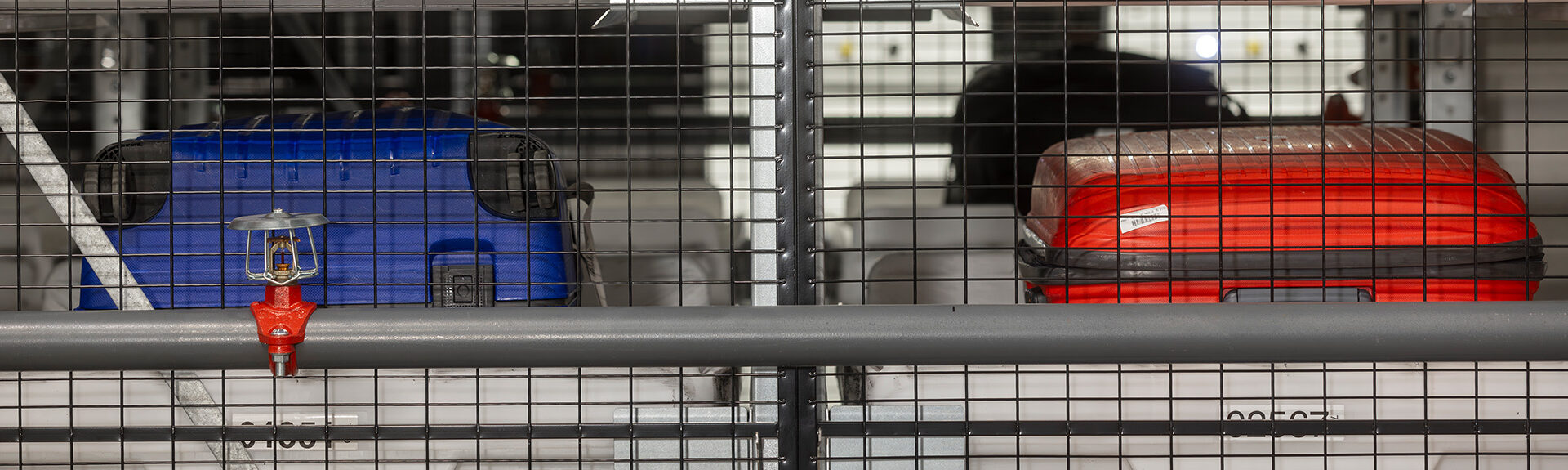
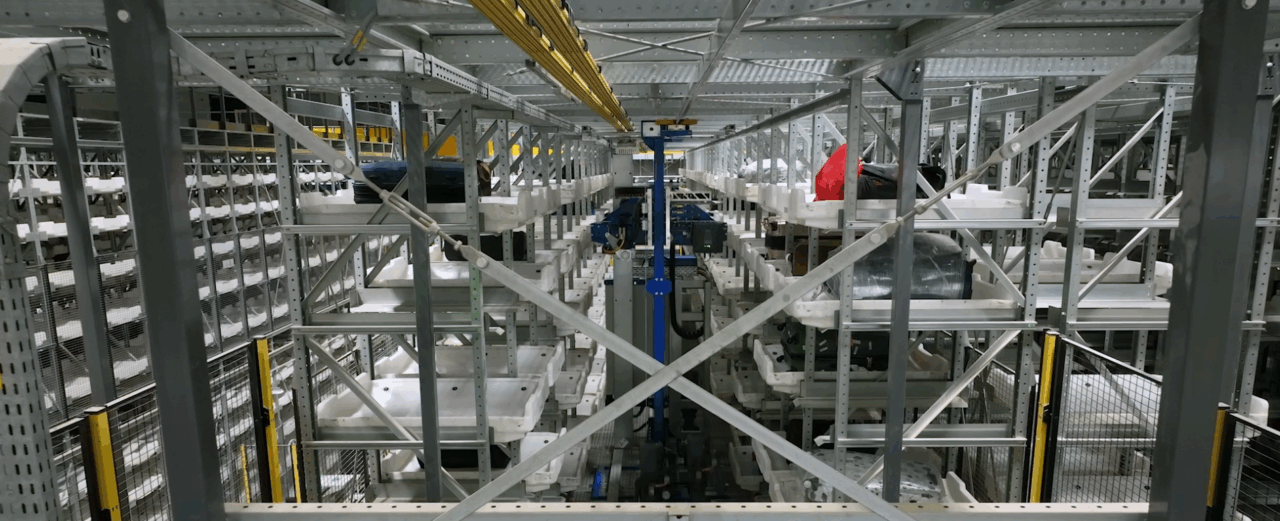
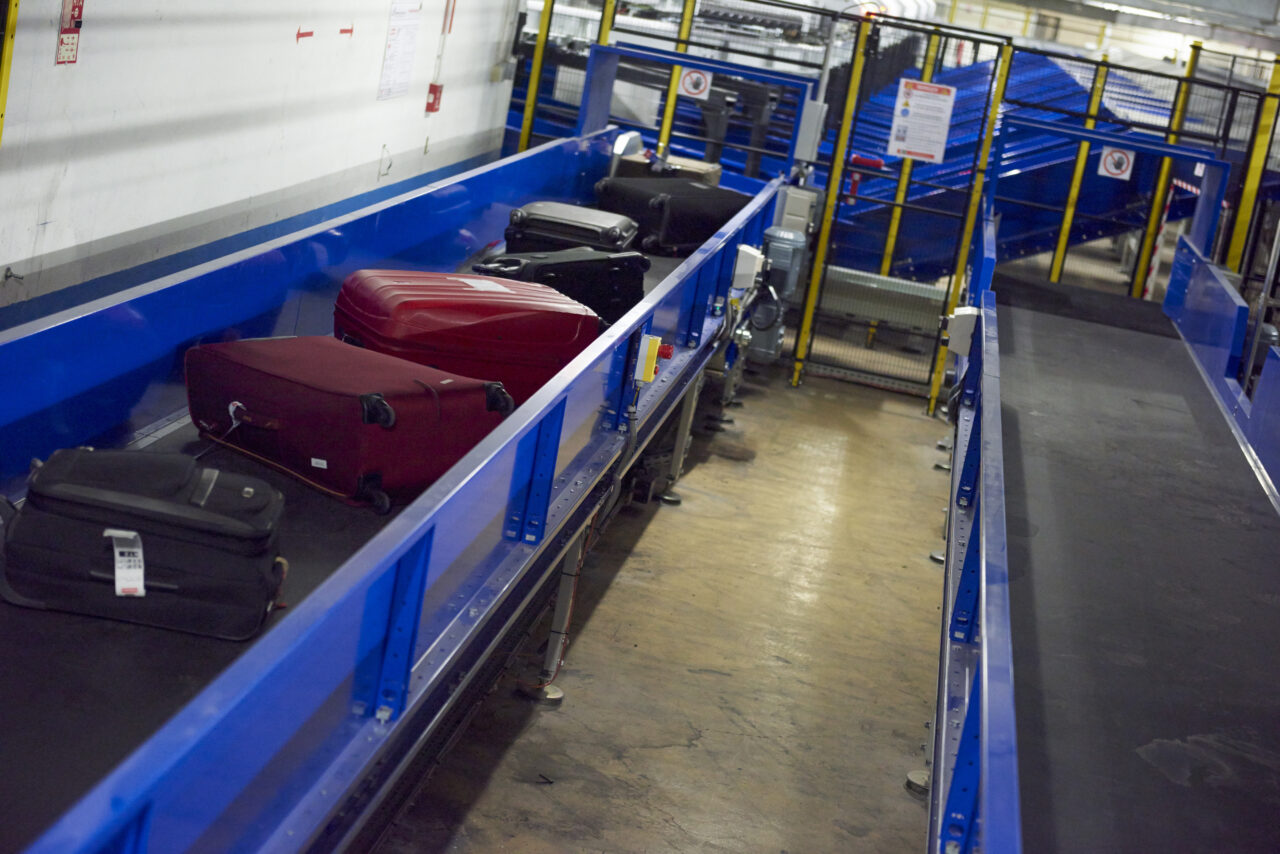
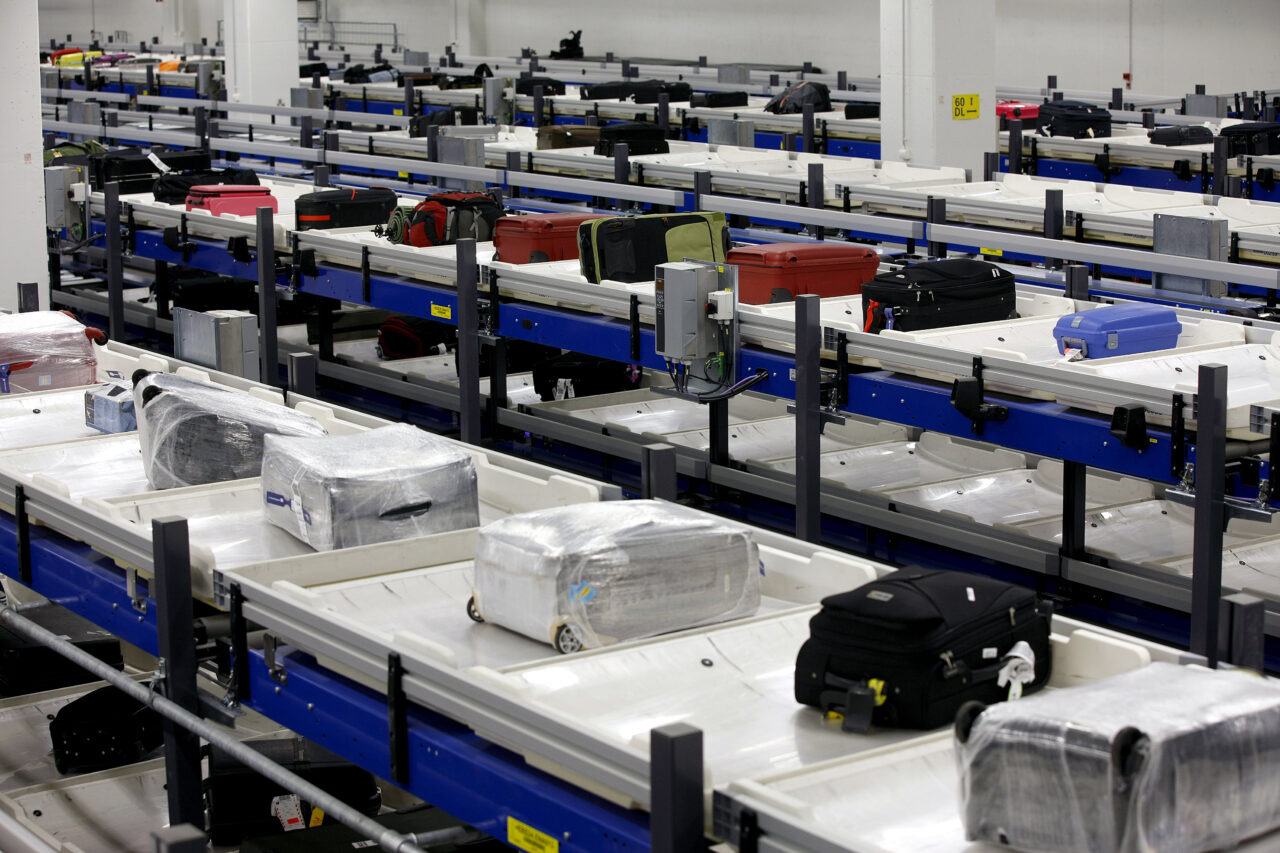
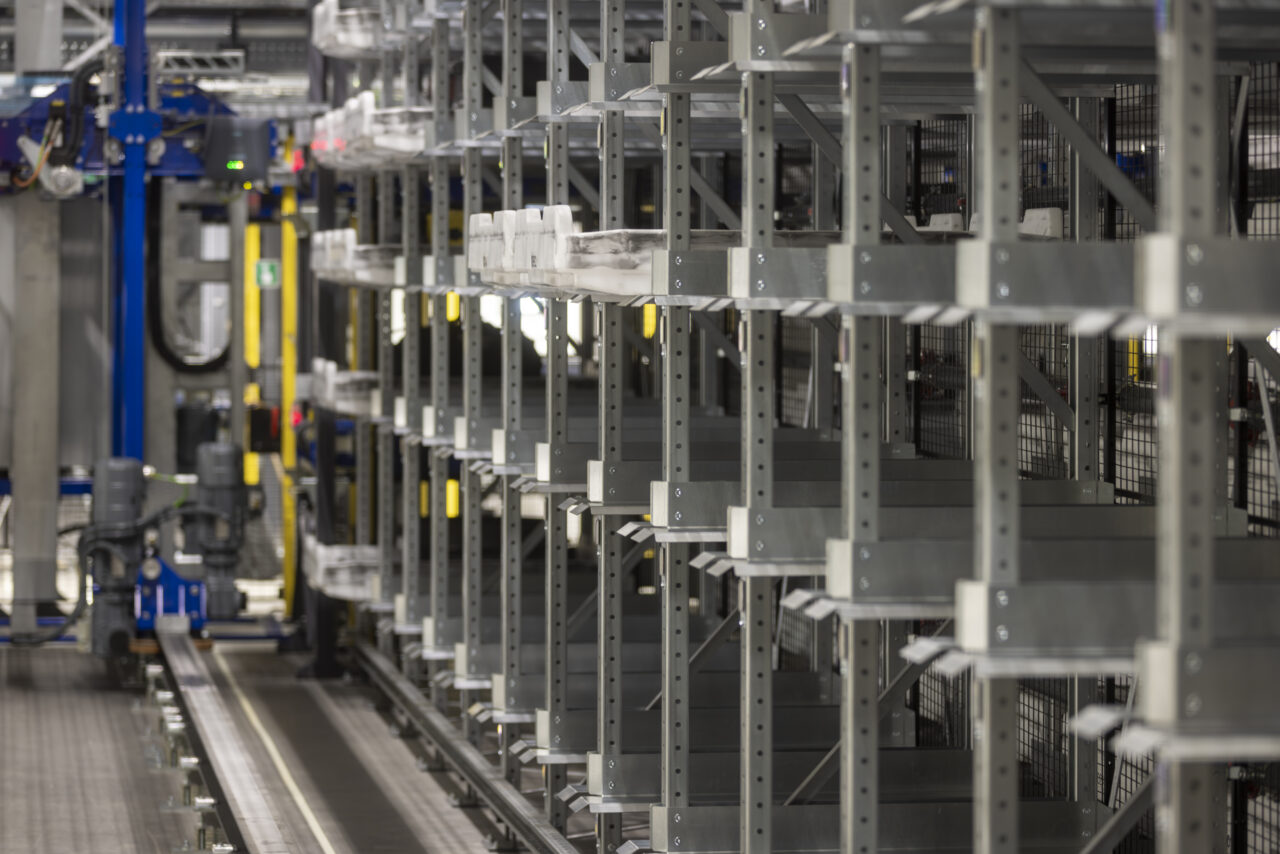
ICS rack storage
Overall, ICS is crucial when bags stay for minutes rather than hours, which is often the case for transfer bags.
Location of storage facility – best location, necessary floorspace
Many airports have been able to take advantage of underused areas to locate their baggage storage – very often in their basements. From a baggage flow perspective, a site close to or above the make-up area is most preferential as this keeps flows compact and minimises transport distances. But not every terminal has spare space.
Because storage systems demand a relatively large footprint, retrofitting them into an existing building often calls for creative engineering. Often airports may need to sacrifice other utility areas or design custom rack-based solutions that use vertical space efficiently – or even build extra external facilities to house the storage.
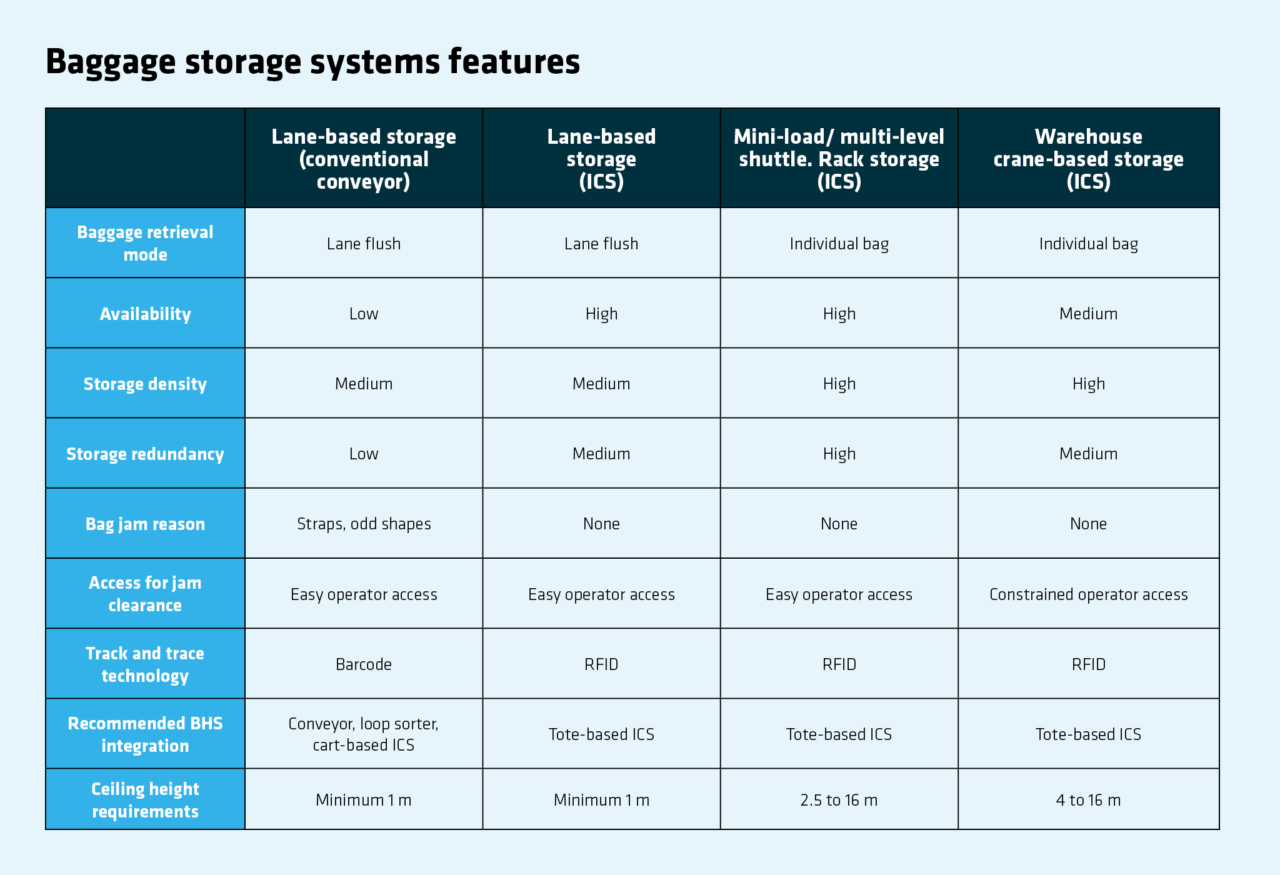
Ceiling height tends to play a decisive role. Conventional warehouse crane systems, for example, require high vertical clearance, whereas mini-load or shuttle-based rack solutions are optimised for medium to high ceilings and easy operator access.
Ultimately, optimal location and use are a balance between space availability, building constraints and operational flow. A well-sited storage facility reduces baggage transport distances, integrates smoothly with check-in and screening, and allows operators to make maximum use of the storage for peak regulation and batch building.
Nevertheless, the design goal is not just where it can fit, but how it can help control the flow.
Designing the ideal baggage storage system
Airports must align the design with their specific operational profile – a system that works well for a regional terminal may be wholly unsuited to a major transfer hub.
Baggage handling capacity
So aligning the baggage storage with the throughput is critically important. Whereas early EBS installations tended to be built with capacity in mind, modern DBS facilities are all about flow.
It’s vital that the baggage storage can take in and release bags quickly enough to match the airport’s BHS. If its rate of flow cannot keep pace and help flatten the peaks, the system becomes a bottleneck.
Peak volumes
Airports rarely operate at a steady flow. Rather, there tend to be peaks during their busiest periods, so both daily and seasonal.
A well-designed DBS smooths these spikes by holding bags and releasing them as perfectly sized batches, keeping baggage handlers productive.
Throughput speed tends to be more important than total storage size.
Transfer baggage needs
For hubs with a high proportion of transfer passengers, single-bag storage access is essential as flight connections can be tight. This allows handlers to pull out the one bag that needs to catch a connection without disturbing hundreds of others.
Only an ICS tote system and rack-storage DBS can deliver the necessary flexibility and performance level to meet the demands of an airport with high transfer traffic.
Recovery from bag jams
Contrary to common belief, the operational availability of a baggage storage system rarely depends on the retrieval machines themselves as these typically offer very high reliability. Instead, availability is threatened by bag jams and the ability to clear them quickly. In tote-based ICS, jams rarely occur because the system transports a standard carrier rather than a loose piece of luggage.
To maintain continuous operations, it is essential that all storage positions are easily accessible to handlers. This ensures that any bag jam can be swiftly cleared without disrupting the wider system. Designing for accessibility and rapid recovery is therefore a critical element in achieving high system availability.
Other operational requirements
Airports should also consider additional factors such as redundancy (backup systems for resilience), recoveries from bag jams, integration with screening and the ability to adapt to changing flight schedules.
A facility that can switch seamlessly between handling early bags, transfer flows and batch building provides far greater long-term value than one built for capacity alone.
How batch building can be optimised by EBS or DBS
Batch building – the process in which bags for the same flight are grouped and then released in timed batches from the baggage storage – keeps handlers working steadily, instead of in fits and starts.
However, its full impact can only be realised by a DBS. Batch building with a regular EBS is limited because lane-based storage can only release bags in sequence, meaning the airport must either dedicate entire lanes to one batch or accept inefficiencies when flights change schedule. The system helps absorb early check-ins, but its ability to support true batch control is constrained.
A DBS enables dynamic batch building. Bags are stored with single-bag access – in ICS totes, racks or shuttle-based systems – meaning handlers can retrieve exactly the right group of bags at exactly the right time. This not only increases make-up efficiency, but also allows pre-builds of ULDs or baggage carts.
DBS transforms storage into a sequencing tool: assembling the right sets of bags in advance and reducing pressure when departure time approaches.
Optimising batch building to control the flow of baggage
Batch building regulates baggage flow across the system. By releasing bags in planned groups, the airport can:
- Smooth peak volumes – avoid surges that overwhelm make-up carousels or staff
- Shorten make-up opening times – allow flights to be processed in a tighter window, freeing space for more departures
- Support on-time departures – ensure containers are packed early, so last-minute bags are the only ones left to chase
- Improve workforce efficiency – handlers load continuously rather than waiting for sporadic arrivals
The software and controls are as critical as the hardware: batch logic must be integrated with the broader baggage flow, from hall to ramp. In this respect, airports that rely on their BHS supplier to design both the storage and its controls are the ones that see the best results.
With the BHS supplier involved, the system can be fine-tuned to local operating realities, aligning with specific flight profiles, peak demand patterns and the constraints of the building layout.
Ultimately, optimised batch building is about control rather than capacity.
The right EBS or DBS lets airports decide when and how bags move, turning storage into a strategic lever for punctuality, efficiency and resilience.