-
- Industry Solutions
-
Airport
- Airport
- Airport Industry
- Project Management
- Baggage Handling System Software and Controls
- Check-In
- Hold Baggage Screening
- Baggage Transport and Sortation Systems
- Baggage Storage and Batch Building Systems
- Make-Up and Unloading Systems
- Baggage Reclaim Systems
- Modernisation Airports
- Airport References
- Building Materials
- Cement / AFR
- Chemical Industry
- Courier, Express & Parcel (CEP)
- E-Commerce
- Minerals & Mining
- Ports & Terminals
- Power Plants
- Fashion
- Consumer Goods
- Retail
- Fertilizer Industry
- Metallurgy
Sustainability made different Our Commitment to Sustainable DevelopmentAs an independent and family-owned company, BEUMER Group is deeply committed to the principles of sustainable development. Through strong partnerships we have developed a deep understanding of the sustainability issues of our key industries and enable our partners to achieve their sustainability goals and targets.Learn more
 -
- Products & Systems
-
Baggage Handling System
- Baggage Handling System
-
Airport Software Suite
- Airport Software Suite
- Business Intelligence – Learning and planning
- Flight Allocation – Being well prepared
- Handler Tools – Providing the right options
- Maintenance Tools – Providing the right means
- Routing & Sorting – Ensuring an efficient execution
- Supervision – Having the complete overview
- Software – The right partner
- Automated Container Unloader
- Baggage Loader
- Baggage Manipulator
- Baggage Unloader
- CrisBag® Independent Carrier System
- CrisBag® Self Bag Drop
- CrisBelt® Conveyor System
- CrisCheck® Check-In Conveyor
- CrisClaim® Baggage Carousels
- CrisStore® Dynamic Racking Solution
- Security Screening
- Tilt-Tray Loop Sortation System
-
Logistics Systems Technology
- Logistics Systems Technology
- BEUMER Flow Parcel Software Suite
-
Warehouse Control System
- Warehouse Control System
- W&D – Business Intelligence – Learn and Plan Through Insights
- W&D – Maintenance and Service Tools – Have the Right Means
- W&D – Material Flow Control – Enable End-to-End Efficiency
- W&D – Order Fulfilment – Ensure Precision and Boost Efficiency
- W&D – Supervision – Have the Complete Overview
- W&D – Training – Create Skilled and Confident Personnel
- Automatic Parcel Singulator
- BEUMER Tipping Station
- BG Line Sorter
- BG Parcel Belt Conveyor
- BG Sorter® CB Cross-Belt
- BG Pouch System
- BG Sorter® ET Tilt-Tray
-
Conveying Technology
- Conveying Technology
- Air-supported belt conveyor
- Apron Conveyors
- Bucket Elevators
- Components
- Conveyor Systems for Alternative Fuels (AFR)
- Drive Stations
- Feeding Hoppers
- Hopper Cars
- Mobile Conveyors
- Overland Belt Conveyors
- Pipe Conveyors
- Screw conveyor
- Shifting Heads
- Tripper Cars
- Troughed Belt Conveyors
- U-Shape Conveyors
- Opencast Mining Systems
- Stockyard Systems
- Mineral Processing
- Port Technology
- Loading & Unloading Systems
- Filling Technology
- Palletising Technology
- Packaging Technology
- Customer Support
-

Disclaimer: This text was originally written in English and translated using AI.
WHAT IS warehouse automation?
Warehouse automation refers to the use of automated technology, mechatronics, robotics, and digital control systems to perform tasks traditionally handled by people. It encompasses everything from industrial conveyors and sorters to robotic picking, pouch systems, and automated storage solutions.
The goal of warehouse automation is to improve speed, accuracy, efficiency, scalability and the work environment in warehouse and distribution operations.
Also known as:
- Automated warehousing
- Automated intralogistics
- Automated warehouse technology
RELATED: Future-proof your fulfilment or distribution centre with automation.
HOW DOES warehouse automation WORK?
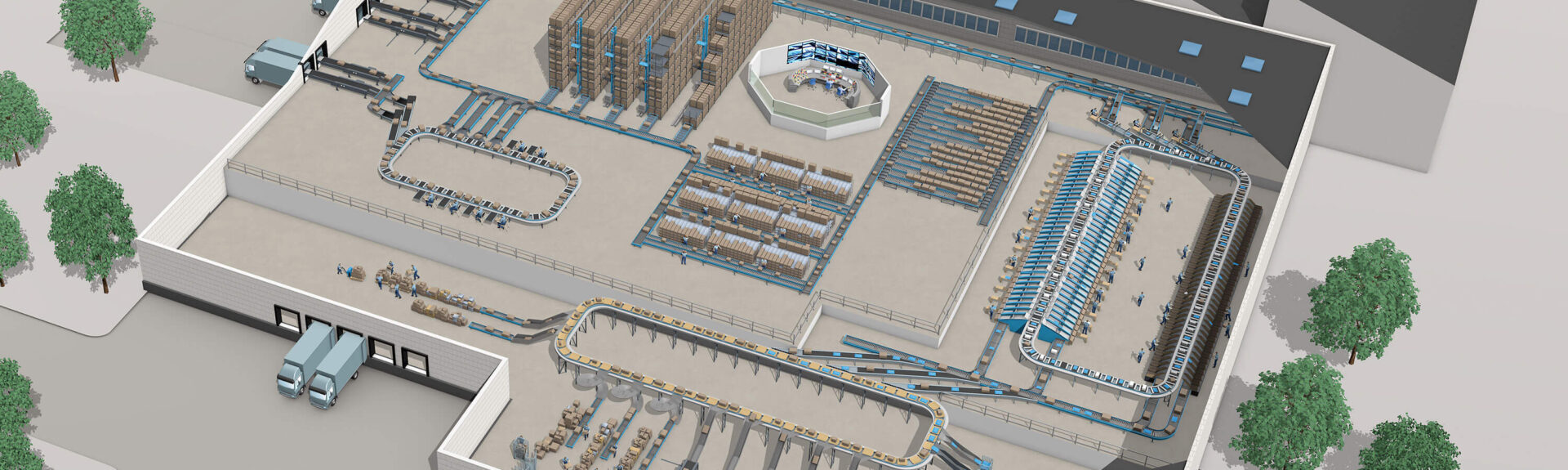
At its core, warehouse automation connects physical material handling equipment with software intelligence, typically via Warehouse Management Systems (WMS) and/or Warehouse Control Systems (WCS).
Typical automated functions in a modern warehouse include:
- Goods receiving – conveyors, scanners, and automated data capture.
- Storage – ASRS, shuttle systems, or automated racking.
- Picking – robotic arms, or voice-picking technologies.
- Buffering, sorting, sequencing and routing – automated sorters and conveyors directing items to the right station.
- Dispatch and shipping – cross-docking, automated labelling, and loading systems.
BENEFITS OF warehouse automation
- Efficiency: Faster throughput and reduced cycle times and handling costs.
- Accuracy: Minimises picking and shipping errors.
- Scalability: Handles seasonal peaks and growth without major increases in labour.
- Cost savings: Lowers operating costs by reducing reliance on manual work.
- Safety: Reduces risks associated with manual handling.
- Sustainability: Optimises energy use and reduces waste.
Download the free e-book: BEUMER Group’s Guide to Warehouse Automation.
THE DIFFERENT LEVELS OF WAREHOUSE AUTOMATION
| Level | Description | Examples |
|---|---|---|
| Manual warehouses | Human-driven processes with minimal tech | Paper-based picking, many manual touch-points |
| Mechanised warehouses | Equipment assists labour | Conveyors, handheld scanners |
| Semi-automated warehouses | Machines handle specific tasks, humans support | Goods-to-person stations, sorters |
| Fully automated warehouses | Integrated automation across all processes | ASRS, robots, integrated sorting and sequencing systems |
HOW BEUMER GROUP SUPPORTS 3PL OPERATIONS
BEUMER Group designs end-to-end warehouse automation and integrate modular, scalable systems that optimise material flow to increase efficiency.
Our automation portfolio includes but is not limited to:
- BG Pouch System – for high-speed, multi-SKU order consolidation and sequencing.
- Line and loop sortation systems – for efficient, large-scale routing of goods.
- Conveyor systems – ensuring continuous, reliable flow of goods.
- Cross-socking solutions – speeding up goods transfer directly between inbound and outbound flows.
- Integration with WMS and WCS – enabling data-driven optimisation and complete system visibility.
RELATED: When to use Cross-belt vs Tilt-tray.
FAQ ABOUT THIRD-PARTY LOGISTICS
What is an example of warehouse automation?
Examples of warehouse automation include conveyors or sorters transporting cartons or SKUs, automated storage systems and retrieval systems, line or loop sorters, and pouch systems for buffering and sequencing orders for packing.
Why is warehouse automation important for logistics companies?
Warehouse automation is important because it allows companies to handle higher order volumes with greater accuracy, lower costs, and faster delivery speeds, all while reducing cost per item handled.
What types of warehouses use automation?
E-commerce fulfilment centres, 3PLs, parcel distribution centres, warehouses, and retail distribution centres all benefit from warehouse automation.
How much does warehouse automation cost?
Costs vary based on size, technology, and integration. While initial investment can be high, the long-term savings in labour cost and efficiency usually outweigh the expense.
What is the difference between warehouse automation and smart warehousing?
Warehouse automation focuses on physical processes, while smart warehousing integrates automation with IoT, AI, and advanced analytics for full digital optimisation.