
-
- Industry Solutions
-
Airport
- Airport
- Airport Industry
- Project Management
- Baggage Handling System Software and Controls
- Check-In
- Hold Baggage Screening
- Baggage Transport and Sortation Systems
- Baggage Storage and Batch Building Systems
- Make-Up and Unloading Systems
- Baggage Reclaim Systems
- Modernisation Airports
- Airport References
- Building Materials
- Cement / AFR
- Chemical Industry
- Courier, Express & Parcel (CEP)
- E-Commerce
- Minerals & Mining
- Ports & Terminals
- Power Plants
- Fashion
- Consumer Goods
- Retail
- Fertilizer Industry
- Metallurgy
Sustainability made different Our Commitment to Sustainable DevelopmentAs an independent and family-owned company, BEUMER Group is deeply committed to the principles of sustainable development. Through strong partnerships we have developed a deep understanding of the sustainability issues of our key industries and enable our partners to achieve their sustainability goals and targets.Learn more
 -
- Products & Systems
-
Baggage Handling System
- Baggage Handling System
-
Airport Software Suite
- Airport Software Suite
- Business Intelligence – Learning and planning
- Flight Allocation – Being well prepared
- Handler Tools – Providing the right options
- Maintenance Tools – Providing the right means
- Routing & Sorting – Ensuring an efficient execution
- Supervision – Having the complete overview
- Software – The right partner
- Automated Container Unloader
- Baggage Loader
- Baggage Manipulator
- Baggage Unloader
- CrisBag® Independent Carrier System
- CrisBag® Self Bag Drop
- CrisBelt® Conveyor System
- CrisCheck® Check-In Conveyor
- CrisClaim® Baggage Carousels
- CrisStore® Dynamic Racking Solution
- Security Screening
- Tilt-Tray Loop Sortation System
-
Logistics Systems Technology
- Logistics Systems Technology
- BEUMER Flow Parcel Software Suite
-
Warehouse Control System
- Warehouse Control System
- W&D – Business Intelligence – Learn and Plan Through Insights
- W&D – Maintenance and Service Tools – Have the Right Means
- W&D – Material Flow Control – Enable End-to-End Efficiency
- W&D – Order Fulfilment – Ensure Precision and Boost Efficiency
- W&D – Supervision – Have the Complete Overview
- W&D – Training – Create Skilled and Confident Personnel
- Automatic Parcel Singulator
- BEUMER Tipping Station
- BG Line Sorter
- BG Parcel Belt Conveyor
- BG Sorter® CB Cross-Belt
- BG Pouch System
- BG Sorter® ET Tilt-Tray
-
Conveying Technology
- Conveying Technology
- Air-supported belt conveyor
- Apron Conveyors
- Bucket Elevators
- Components
- Conveyor Systems for Alternative Fuels (AFR)
- Drive Stations
- Feeding Hoppers
- Hopper Cars
- Mobile Conveyors
- Overland Belt Conveyors
- Pipe Conveyors
- Screw conveyor
- Shifting Heads
- Tripper Cars
- Troughed Belt Conveyors
- U-Shape Conveyors
- Opencast Mining Systems
- Stockyard Systems
- Mineral Processing
- Port Technology
- Loading & Unloading Systems
- Filling Technology
- Palletising Technology
- Packaging Technology
- Customer Support
-


Disclaimer: This text was originally written in English and translated using AI.
WHAT IS a warehouse management system (WMS)?
A Warehouse Management System (WMS) is a software solution designed to optimise and control daily warehouse operations. WMS platforms provide real-time visibility into stock levels, track the movement of goods, and streamline workflows such as picking, packing, and shipping.
Also known as:
- Warehouse control software
- Inventory management system
- Distribution centre management software
HOW DOES a warehouse management system work?
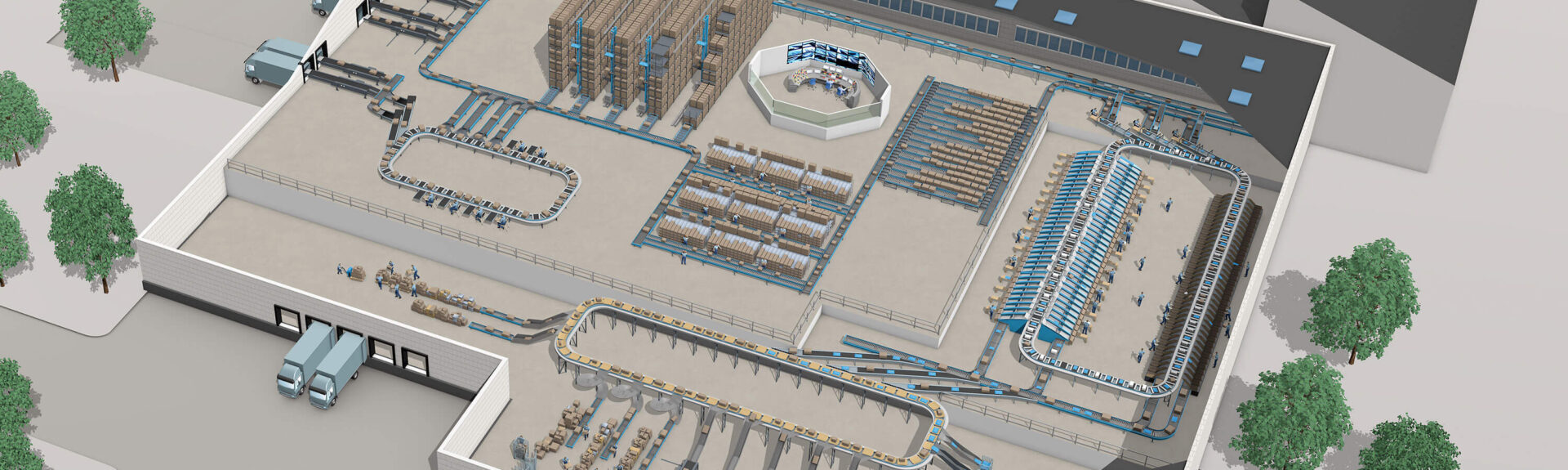
A WMS connects people, processes, and technology inside the warehouse. It integrates with upstream systems such as Enterprise Resource Planning (ERP) and downstream systems like Transportation Management Systems (TMS).
Typical WMS functionalities include:
- Stock tracking – real-time visibility into inventory levels and locations.
- Order management – routing orders to the right picking and packing processes.
- Labour management – optimising workforce productivity through task allocation.
- Automation control – integration with material handling systems such as conveyors, sorters, and pouch systems.
- Reporting and data analytics – dashboards to monitor KPIs, efficiency, and bottlenecks.
By combining these functions, a WMS enables warehouses to handle higher throughput, reduce errors, and adapt quickly to demand fluctuations.
RELATED: How to make a business case for implementing a material handling system
BENEFITS OF USING A wms
- Efficiency: Automates manual processes, speeding up fulfilment.
- Accuracy: Reduces picking errors and stock discrepancies.
- Scalability: Supports warehouse growth and peak demand without proportional labour increases.
- Integration: Seamlessly links with ERP, TMS, and automation systems.
- Customer satisfaction: Faster, more reliable deliveries.
RELATED: The future is now: Embracing digitalisation in your fulfilment centre
WMS and WCS – WHAT’S THE DIFFERENCE?
A WMS manages warehouse operations at a strategic level, while a Warehouse Control System (WCS) controls material handling systems in real time. Together, they create a seamless link between planning and execution.
| Feature | WMS (Warehouse Management System) | WCS (Warehouse Control System) |
|---|---|---|
| Focus | Manages overall warehouse operations | Directly controls automation equipment |
| Scope | Stock, orders, labour, reporting | Conveyors, AS/RS, loop sorters, pouch systems etc. |
| Integration | Interfaces with ERP and TMS | Interfaces with warehouse automation |
| Role | Strategic/operational planning | Real-time equipment execution |
HOW BEUMER GROUP SUPPORTS wms OPERATIONS
BEUMER Group supports warehouse and distribution business experts in designing brand-new distribution centres or expanding existing facilities. We integrate everything from complete warehouse management systems to individual software modules that integrate seamlessly with existing WMS and ERP platforms.
We design and implement tailor-made software suites that enhance supply chain management (SCM) through intuitive user interfaces, remote access, and advanced functionality.
FAQ ABOUT WAREHOUSE MANAGEMENT SYSTEMS
How does a WMS differ from ERP systems?
ERP systems manage enterprise-wide processes such as finance, HR, and procurement. A WMS focuses specifically on warehouse operations, though the two systems often integrate to share data.
When should a company invest in a WMS?
Businesses should consider a WMS when manual stock management becomes inefficient, error rates increase, or throughput requirements outgrow existing processes. For e-commerce and 3PLs, a WMS is essential for scaling.
How much does a WMS cost?
The cost of a WMS depends on the scale, number of users, and integration requirements. Smaller systems may be relatively affordable, while enterprise-level solutions with automation integration can represent a large investment. However, the long-term savings in efficiency and labour often outweigh initial costs.
Can a WMS integrate with automation systems?
Yes. Modern WMS platforms are designed to connect with automated materail handling technologies such as pouch systems, automated storage and retrieval systems (ASRS), and other sortation solutions. BEUMER Group specialises in integrating automation with WMS platforms to ensure seamless operation.
What are the main challenges when implementing a WMS?
Challenges include data migration, workforce training, and ensuring smooth integration with existing ERP or automation systems. Choosing an experienced supplier and integrator, like BEUMER Group, reduces risks and ensures a faster time-to-value.
How long does it take to implement a WMS?
Implementation timelines vary. A basic system may take a few months, while complex, multi-site rollouts with automation integration can take longer.
What is a 3PL warehouse management system?
A 3PL WMS is a warehouse management system designed specifically for third-party logistics providers. Unlike standard WMS platforms, a 3PL WMS supports multi-client operations, flexible billing models, and rapid onboarding of new customers.
What are the four types of WMS?
The four main types of WMS are:
- Standalone WMS – focused solely on warehouse functions like picking and inventory.
- Supply chain execution modules – WMS features embedded within a broader supply chain platform.
- ERP-integrated WMS – warehouse functionality built into enterprise systems such as SAP or Oracle.
- Cloud-based WMS – flexible, subscription-based systems that scale easily across multiple sites.