
-
- Industry Solutions
-
Airport
- Airport
- Airport Industry
- Project Management
- Baggage Handling System Software and Controls
- Check-In
- Hold Baggage Screening
- Baggage Transport and Sortation Systems
- Baggage Storage and Batch Building Systems
- Make-Up and Unloading Systems
- Baggage Reclaim Systems
- Modernisation Airports
- Airport References
- Building Materials
- Cement / AFR
- Chemical Industry
- Courier, Express & Parcel (CEP)
- E-Commerce
- Minerals & Mining
- Ports & Terminals
- Power Plants
- Fashion
- Consumer Goods
- Retail
- Fertilizer Industry
- Metallurgy
Sustainability made different Our Commitment to Sustainable DevelopmentAs an independent and family-owned company, BEUMER Group is deeply committed to the principles of sustainable development. Through strong partnerships we have developed a deep understanding of the sustainability issues of our key industries and enable our partners to achieve their sustainability goals and targets.Learn more
 -
- Products & Systems
-
Baggage Handling System
- Baggage Handling System
-
Airport Software Suite
- Airport Software Suite
- Business Intelligence – Learning and planning
- Flight Allocation – Being well prepared
- Handler Tools – Providing the right options
- Maintenance Tools – Providing the right means
- Routing & Sorting – Ensuring an efficient execution
- Supervision – Having the complete overview
- Software – The right partner
- Automated Container Unloader
- Baggage Loader
- Baggage Manipulator
- Baggage Unloader
- CrisBag® Independent Carrier System
- CrisBag® Self Bag Drop
- CrisBelt® Conveyor System
- CrisCheck® Check-In Conveyor
- CrisClaim® Baggage Carousels
- CrisStore® Dynamic Racking Solution
- Security Screening
- Tilt-Tray Loop Sortation System
-
Logistics Systems Technology
- Logistics Systems Technology
- BEUMER Flow Parcel Software Suite
-
Warehouse Control System
- Warehouse Control System
- W&D – Business Intelligence – Learn and Plan Through Insights
- W&D – Maintenance and Service Tools – Have the Right Means
- W&D – Material Flow Control – Enable End-to-End Efficiency
- W&D – Order Fulfilment – Ensure Precision and Boost Efficiency
- W&D – Supervision – Have the Complete Overview
- W&D – Training – Create Skilled and Confident Personnel
- Automatic Parcel Singulator
- BEUMER Tipping Station
- BG Line Sorter
- BG Parcel Belt Conveyor
- BG Sorter® CB Cross-Belt
- BG Pouch System
- BG Sorter® ET Tilt-Tray
-
Conveying Technology
- Conveying Technology
- Air-supported belt conveyor
- Apron Conveyors
- Bucket Elevators
- Components
- Conveyor Systems for Alternative Fuels (AFR)
- Drive Stations
- Feeding Hoppers
- Hopper Cars
- Mobile Conveyors
- Overland Belt Conveyors
- Pipe Conveyors
- Screw conveyor
- Shifting Heads
- Tripper Cars
- Troughed Belt Conveyors
- U-Shape Conveyors
- Opencast Mining Systems
- Stockyard Systems
- Mineral Processing
- Port Technology
- Loading & Unloading Systems
- Filling Technology
- Palletising Technology
- Packaging Technology
- Customer Support
-


Disclaimer: This text was originally written in English and translated using AI.
WHAT IS a warehouse control system (WCS)?
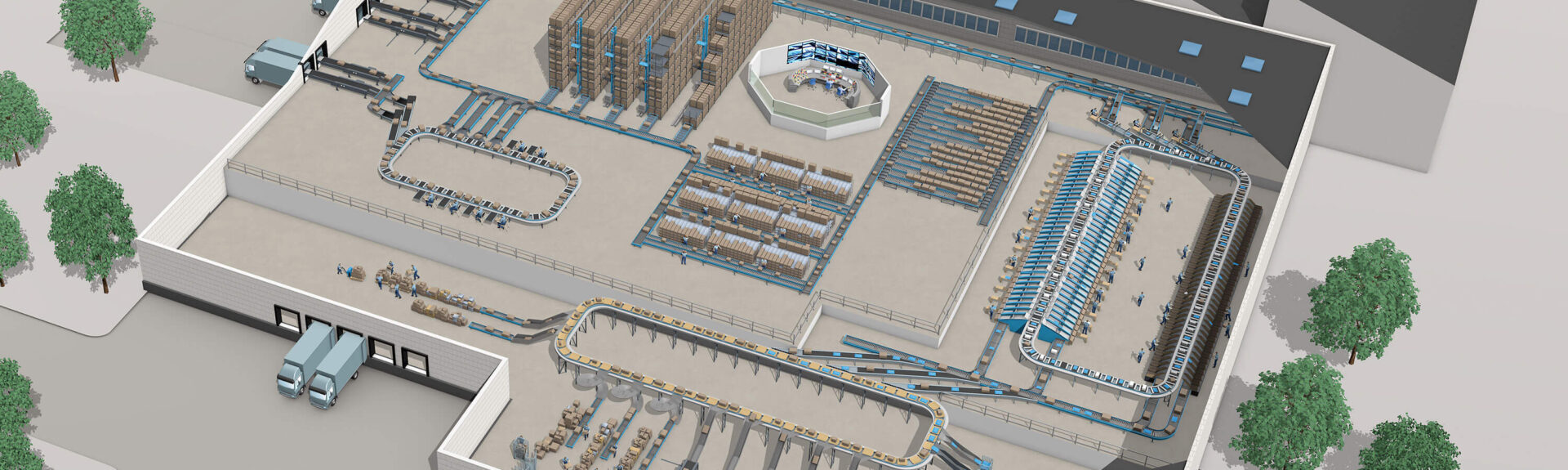
A Warehouse Control System (WCS) is software that manages the real-time control of automated materials handling systems and equipment inside a warehouse or distribution centre. It acts as the link between high-level WMS planning systems and the physical handling equipment.
Unlike a Warehouse Management System (WMS), which oversees overall operations such as inventory and orders, a WCS directs the flow of goods across conveyors, sortation systems, and automated storage and retrieval solutions.
Also known as:
- Warehouse execution software
- Automation control system
- Material handling system controller
RELATED: Supply chain management software: The choice of progressive companies.
HOW DOES a warehouse control system work?
The WCS works by connecting directly to programmable logic controllers (PLCs) that drive automation hardware. It receives instructions from the WMS and translates them into specific equipment commands.
Typical WCS functions include:
- Routing decisions – determining which conveyor or sorter path each item should follow.
- Real-time control – monitoring and adjusting automation equipment for efficiency and uptime.
- Load balancing – distributing workload across multiple systems to avoid bottlenecks.
- Exception handling – managing issues such as jams, errors, or mis-routes.
- Performance data – feeding live equipment data back into the WMS or reporting dashboards.
By orchestrating material flows, the WCS ensures that goods move seamlessly through automated systems with minimal delay.
BENEFITS OF A wcs
- Operational efficiency: Ensures automated equipment runs smoothly and with minimal downtime.
- Real-time responsiveness: Adjusts routing and load balancing instantly to avoid bottlenecks.
- Seamless integration: Connects higher-level systems (WMS/ERP) with automation for end-to-end synchronisation.
- Improved visibility: Provides live insights into equipment status, throughput, and system performance.
- Flexibility: Can adapt to new automation technologies and changing warehouse needs.
- Cost savings: Maximises utilisation of automation assets, reducing errors and unnecessary labour.
RELATED: The benefits of open, integrable software for fashion fulfillment.
HOW BEUMER GROUP SUPPORTS wcs integration
BEUMER Group’s Warehouse Control System (WCS) ensures seamless communication between warehouse management systems and automation to optimise material flow, visibility, and reliability.
Key capabilities include:
- Intelligent control – real-time item identification and material flow across sortation, fulfilment, and e-commerce processes.
- Digital tools – simulations, emulations, AI insights, heat maps, and 3D visualisations for better planning.
- Visualisation – web-based dashboards with intuitive layouts and live flow monitoring.
- Flow precision – batch sortation logic based on urgency, SKU velocity, and picking efficiency.
- Automation control – integrates conveyors, sortation systems, ASRS, and robotics.
- Secure processes – built according to CMMI Level 3 and ISO 27001 certified processes for reliability and data protection.
As both a supplier and integrator, BEUMER Group delivers system designs with flexible WCS solutions that optimise automation, improve efficiency, and reduce costs.
FAQ ABOUT warehouse control systems
What is an example of a WCS?
A WCS may be used to control conveyors, sortation systems, such as pouch systems. An example of a WCS is BEUMER Group’s WCS modules that integrate with the BG Pouch System to manage item routing and sequencing in real time.
How does a WCS differ from a WMS?
A WMS manages warehouse processes such as orders, inventory, and labour. A WCS focuses on the real-time control of automated equipment. The two systems complement each other.
When should a company use a WCS?
A company should consider using a WCS when warehouses operate with high levels of automation, such as conveyors, ASRS, or sorters. It ensures equipment is used efficiently and downtime is minimised.
Can a WCS work without a WMS?
While a WCS can control automation independently, it is also effective when integrated with a WMS. The WMS sets overall priorities, while the WCS executes them at the equipment level.
What industries benefit most from a WCS?
Industries with high-volume distribution centres — such as e-commerce, retail, and the courier, express and parcel industry (CEP) – rely heavily on WCS to keep automated operations running efficiently.