-
- Industry Solutions
-
Airport
- Airport
- Airport Industry
- Project Management
- Baggage Handling System Software and Controls
- Check-In
- Hold Baggage Screening
- Baggage Transport and Sortation Systems
- Baggage Storage and Batch Building Systems
- Make-Up and Unloading Systems
- Baggage Reclaim Systems
- Modernisation Airports
- Airport References
- Building Materials
- Cement / AFR
- Chemical Industry
- Courier, Express & Parcel (CEP)
- E-Commerce
- Minerals & Mining
- Ports & Terminals
- Power Plants
- Fashion
- Consumer Goods
- Retail
- Fertilizer Industry
- Metallurgy
Sustainability made different Our Commitment to Sustainable DevelopmentAs an independent and family-owned company, BEUMER Group is deeply committed to the principles of sustainable development. Through strong partnerships we have developed a deep understanding of the sustainability issues of our key industries and enable our partners to achieve their sustainability goals and targets.Learn more
 -
- Products & Systems
-
Baggage Handling System
- Baggage Handling System
-
Airport Software Suite
- Airport Software Suite
- Business Intelligence – Learning and planning
- Flight Allocation – Being well prepared
- Handler Tools – Providing the right options
- Maintenance Tools – Providing the right means
- Routing & Sorting – Ensuring an efficient execution
- Supervision – Having the complete overview
- Software – The right partner
- Automated Container Unloader
- Baggage Loader
- Baggage Manipulator
- Baggage Unloader
- CrisBag® Independent Carrier System
- CrisBag® Self Bag Drop
- CrisBelt® Conveyor System
- CrisCheck® Check-In Conveyor
- CrisClaim® Baggage Carousels
- CrisStore® Dynamic Racking Solution
- Security Screening
- Tilt-Tray Loop Sortation System
-
Logistics Systems Technology
- Logistics Systems Technology
- BEUMER Flow Parcel Software Suite
-
Warehouse Control System
- Warehouse Control System
- W&D – Business Intelligence – Learn and Plan Through Insights
- W&D – Maintenance and Service Tools – Have the Right Means
- W&D – Material Flow Control – Enable End-to-End Efficiency
- W&D – Order Fulfilment – Ensure Precision and Boost Efficiency
- W&D – Supervision – Have the Complete Overview
- W&D – Training – Create Skilled and Confident Personnel
- Automatic Parcel Singulator
- BEUMER Tipping Station
- BG Line Sorter
- BG Parcel Belt Conveyor
- BG Sorter® CB Cross-Belt
- BG Pouch System
- BG Sorter® ET Tilt-Tray
-
Conveying Technology
- Conveying Technology
- Air-supported belt conveyor
- Apron Conveyors
- Bucket Elevators
- Components
- Conveyor Systems for Alternative Fuels (AFR)
- Drive Stations
- Feeding Hoppers
- Hopper Cars
- Mobile Conveyors
- Overland Belt Conveyors
- Pipe Conveyors
- Screw conveyor
- Shifting Heads
- Tripper Cars
- Troughed Belt Conveyors
- U-Shape Conveyors
- Opencast Mining Systems
- Stockyard Systems
- Mineral Processing
- Port Technology
- Loading & Unloading Systems
- Filling Technology
- Palletising Technology
- Packaging Technology
- Customer Support
-

Disclaimer: This text was originally written in English and translated using AI.
WHAT IS a lights-out warehouse?
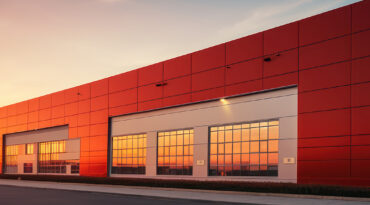
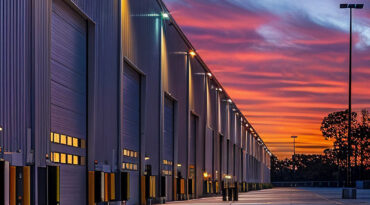
A “lights-out warehouse” is a fully automated warehouse that requires little to no human presence on the shop floor, allowing operations to run without lighting or staff onsite. Because of this, it is sometimes also referred to as a “dark warehouse”.
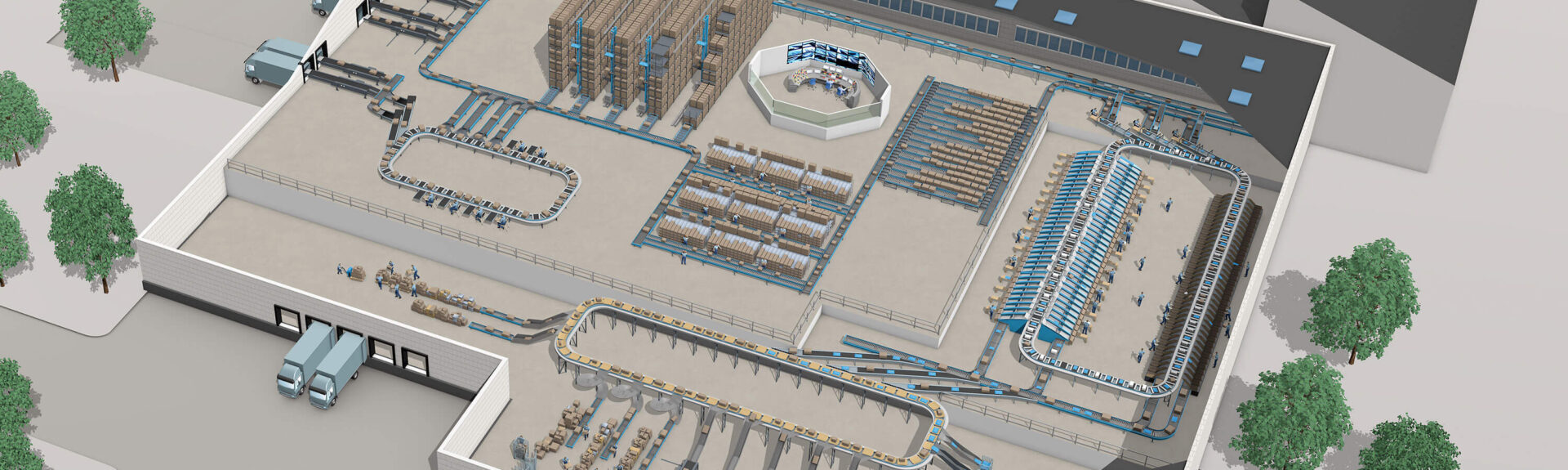
These warehouses rely on advanced automation – such as conveyors, sorters, pouch systems, and robotic picking – to manage storage, retrieval, sorting etc. for order fulfilment.
Also known as:
- Dark warehouse
- Autonomous warehouse
RELATED: Dark Warehouses to grab the spotlight in 2024
HOW DOES a lights-out warehouse WORK?
Lights-out warehouses combine completely automated material handling equipment with advanced control software such as Warehouse Management Systems (WMS) and/or Warehouse Control Systems (WCS).
Key features of a dark warehouse include:
- Automated storage – ASRS, shuttle systems, and robotics manage inventory.
- Automated transport – conveyors, sorters, and pouch systems move goods across the facility.
- Automated picking – robotic or goods-to-person systems handle order selection.
- Software integration – WMS and WCS synchronise data with automation to optimise flows.
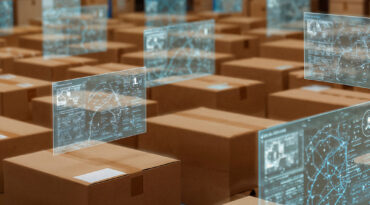
- Predictive analytics – AI-driven insights anticipate demand, faults, and maintenance needs.
BENEFITS OF a lights-out warehouse
- Efficiency: Lights-out warehouses operate 24/7 without interruption.
- Accuracy: Reduces picking and handling errors.
- Labour optimisation: Minimises reliance on human labour in high-cost or labour-scarce markets.
- Energy savings: Requires little or no lighting and can optimise HVAC use.
- Safety: Removes people from potentially hazardous environments.
- Scalability: Handles high throughput and seasonal peaks.
LIGHTS-OUT WAREHOUSE VS TRADITIONAL WAREHOUSE
| Feature | Lights-out warehouse | Traditional warehouse |
|---|---|---|
| Workforce | Minimal human presence | Labour-intensive |
| Lighting | Little or no lighting required | Fully lit for human operators |
| Processes | Automated storage, picking, transport | Manual or semi-automated processes |
| Operating hours | 24/7 possible | Limited by shift schedules |
| Accuracy | High due to automation | Prone to human error |
HOW BEUMER GROUP SUPPORTS lights-out warehouses
While BEUMER Group does not supply all the automation elements directly, we act as a trusted integrator, connecting warehouse management systems with automation technologies to enable lights-out warehouse operations.
Our technologies play a central role in making dark warehouses a reality:
- BG Pouch System – handles dynamic picking, sequencing, and order consolidation in fully automated environments.
- Automated line and loop sortation systems – route goods with high accuracy across complex flows.
- Conveyor systems – ensure continuous, reliable movement of items throughout the facility.
- Integration with WMS and WCS – synchronises data, control, and automation for seamless dark warehouse performance.
FAQ ABOUT lights-out warehouses
Why is it called a lights-out warehouse?
It’s called a lights-out warehouse because human workers are not needed for most operations, the facility can run without lighting – relying solely on automation.
What technologies enable a lights-out warehouse?
Lights-out warehouses rely on conveyors, sorters, pouch systems, ASRS, robotic picking, and software platforms like WMS and WCS.
What are the challenges of a lights-out warehouse?
Challenges of lights-out warehouses include high upfront investment costs, complex system integration, and the need for robust IT infrastructure. Lights-out warehouses also require advanced maintenance expertise, and handling unexpected exceptions without human presence can be difficult.
What industries use lights-out warehouses?
E-commerce, retail, and parcel logistics are expected to be the first major adopters of lights-out warehouses, driven by their need for high throughput, accuracy, and scalable operations.
What are the future impacts of a lights-out warehouse?
Lights-out warehouses are set to reshape supply chains by enabling round-the-clock operations, reduced labour dependency, and greater resilience to workforce shortages. As automation and AI mature, lights-out warehouses are expected to become more common, especially in e-commerce and parcel logistics.
How to start a lights-out warehouse?
Most businesses begin with a phased approach, automating key processes such as picking and sortation before moving towards fully lights-out operations. Success depends on choosing scalable automation, strong integration with WMS/WCS, and reliable partners such as BEUMER Group to align systems. Careful planning, simulation, and testing are critical to reduce risks and ensure a smooth transition.