-
- Industry Solutions
-
Airport
- Airport
- Airport Industry
- Project Management
- Baggage Handling System Software and Controls
- Check-In
- Hold Baggage Screening
- Baggage Transport and Sortation Systems
- Baggage Storage and Batch Building Systems
- Make-Up and Unloading Systems
- Baggage Reclaim Systems
- Modernisation Airports
- Airport References
- Building Materials
- Cement / AFR
- Chemical Industry
- Courier, Express & Parcel (CEP)
- E-Commerce
- Minerals & Mining
- Ports & Terminals
- Power Plants
- Fashion
- Consumer Goods
- Retail
- Fertilizer Industry
- Metallurgy
Sustainability made different Our Commitment to Sustainable DevelopmentAs an independent and family-owned company, BEUMER Group is deeply committed to the principles of sustainable development. Through strong partnerships we have developed a deep understanding of the sustainability issues of our key industries and enable our partners to achieve their sustainability goals and targets.Learn more
 -
- Products & Systems
-
Baggage Handling System
- Baggage Handling System
-
Airport Software Suite
- Airport Software Suite
- Business Intelligence – Learning and planning
- Flight Allocation – Being well prepared
- Handler Tools – Providing the right options
- Maintenance Tools – Providing the right means
- Routing & Sorting – Ensuring an efficient execution
- Supervision – Having the complete overview
- Software – The right partner
- Automated Container Unloader
- Baggage Loader
- Baggage Manipulator
- Baggage Unloader
- CrisBag® Independent Carrier System
- CrisBag® Self Bag Drop
- CrisBelt® Conveyor System
- CrisCheck® Check-In Conveyor
- CrisClaim® Baggage Carousels
- CrisStore® Dynamic Racking Solution
- Security Screening
- Tilt-Tray Loop Sortation System
-
Logistics Systems Technology
- Logistics Systems Technology
- BEUMER Flow Parcel Software Suite
-
Warehouse Control System
- Warehouse Control System
- W&D – Business Intelligence – Learn and Plan Through Insights
- W&D – Maintenance and Service Tools – Have the Right Means
- W&D – Material Flow Control – Enable End-to-End Efficiency
- W&D – Order Fulfilment – Ensure Precision and Boost Efficiency
- W&D – Supervision – Have the Complete Overview
- W&D – Training – Create Skilled and Confident Personnel
- Automatic Parcel Singulator
- BEUMER Tipping Station
- BG Line Sorter
- BG Parcel Belt Conveyor
- BG Sorter® CB Cross-Belt
- BG Pouch System
- BG Sorter® ET Tilt-Tray
-
Conveying Technology
- Conveying Technology
- Air-supported belt conveyor
- Apron Conveyors
- Bucket Elevators
- Components
- Conveyor Systems for Alternative Fuels (AFR)
- Drive Stations
- Feeding Hoppers
- Hopper Cars
- Mobile Conveyors
- Overland Belt Conveyors
- Pipe Conveyors
- Screw conveyor
- Shifting Heads
- Tripper Cars
- Troughed Belt Conveyors
- U-Shape Conveyors
- Opencast Mining Systems
- Stockyard Systems
- Mineral Processing
- Port Technology
- Loading & Unloading Systems
- Filling Technology
- Palletising Technology
- Packaging Technology
- Customer Support
-


Disclaimer: This text was originally written in English and translated using AI.
WHAT IS an automated storage and retrieval system (Asrs)?
An Automated Storage and Retrieval System (ASRS) is a computer-controlled system designed to automatically place and retrieve goods from defined storage locations.
These systems maximise vertical and horizontal space, improve inventory accuracy, and enable high-density storage in warehouses and distribution centres.
Also known as:
- Automated warehouse system
- Automated storage system
- Robotic storage system
RELATED: How to organise your fashion fulfilment centre for both B2B and B2C.
HOW DOES an asrs WORK?
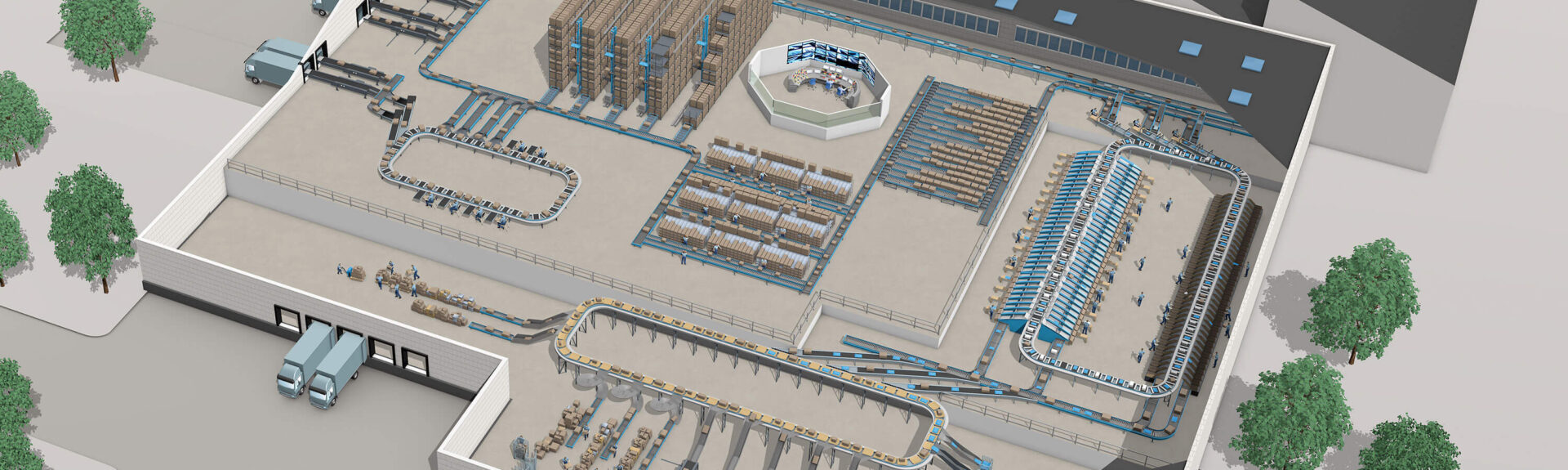
ASRS solutions use shuttles, cranes, or robotics to move goods into and out of storage. Controlled by a Warehouse Control System (WCS) or Warehouse Management System (WMS), they ensure precise, automated movement of inventory.
Typical ASRS technologies include:
- Unit-load systems – large cranes handling pallets or heavy items.
- Mini-load systems – smaller shuttles or cranes handling totes and cartons.
- Shuttle systems – high-speed carriers moving goods across multiple levels.
- Carousel systems – horizontal or vertical carousels rotating goods to pick stations.
BENEFITS OF an asrs
- Space efficiency: Maximises cubic storage capacity in warehouses.
- Speed: Accelerates picking and replenishment cycles.
- Accuracy: Reduces human error in storage and retrieval.
- Labour savings: Minimises reliance on manual handling.
- Safety: Reduces risks associated with forklifts and manual lifting.
ASRS VS MANUAL STORAGE
| Feature | ASRS | Manual storage |
|---|---|---|
| Speed | High-speed retrieval and replenishment | Dependent on labour availability |
| Space use | Maximises vertical and horizontal capacity | Limited by racking and floor space |
| Accuracy | Automated, precise, low error rates | Prone to human error |
| Labour | Minimal manual involvement | Labour-intensive, higher operating costs |
| Safety | Reduces forklift and lifting hazards | Higher risk for warehouse staff |
HOW BEUMER GROUP designs SUPPORT asrs operations
While BEUMER Group does not directly supply Automated Storage and Retrieval Systems, we integrate our solutions seamlessly with ASRS platforms to ensure optimal warehouse and fulfillment performance.
Acting as a system integrator, BEUMER connects ASRS with warehouse management and control systems, as well as with advanced automation such as loop, line and pouch systems.
Our ASRS integration expertise covers:
- WMS/WCS integration – ensuring ASRS functions align with order management and inventory control.
- Automation connectivity – linking ASRS to conveyors and sortation systems for smooth material flow.
- System emulation and testing – validating ASRS integration before go-live to guarantee reliability.
- Scalable design – adapting to growing number of SKUs, order volumes, and warehouse expansions.
FAQ ABOUT asrs
What is an example of an ASRS?
Examples of ASRS include pallet-handling unit-load systems, tote-handling mini-load systems, and shuttle-based storage.
What types of ASRS exist?
The main types of ASRS are unit-load, mini-load, shuttle, and carousel systems, each suited to different product sizes, speeds, and warehouse layouts.
Why is ASRS important?
ASRS helps warehouses increase efficiency, reduce labour costs, and optimise storage space – critical in e-commerce, fashion and in high-density distribution centres.
How does ASRS integrate with a WMS or WCS?
The WMS or WCS sends commands to the ASRS, directing where goods should be stored or retrieved.
What industries use ASRS?
Retail, e-commerce, automotive, pharmaceuticals, and food & beverage are major adopters of ASRS due to their high-volume and accuracy requirements.
When was ASRS invented?
Automated Storage and Retrieval Systems (ASRS) were first developed in the 1960s, initially for handling palletised loads in manufacturing and distribution. Since then, the technology has evolved into a wide range of solutions including mini-load systems, shuttles, and carousels.